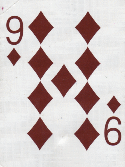
The nine of diamonds has been known as the Curse of Scotland for a long time, the first record in print being in 1710. The reason for this is not clear, but there have been plenty of explanations put forward over the years.
The most common one comes from the card game 'Pope Joan', where the
9 is called the Pope, the antichrist of Scottish religious reformers.
Pope Joan is played for money so another reason for the curse might come from the variant of the game where the holder of the card pays double, although there is no particular connection with Scotland in this.
Another card game similar to Pope Joan is 'Comet' (aka Comette or Commit),
where the 9 is the most important card. It is said that this
game was introduced to Scotland by the queen of James V, Mary of Lorraine
a.k.a. Mary of Guise (1515 - 1560) (or by a Duke of York according to another source),
and that it brought many Scottish families to ruin.
However to be ruined by Comet seems implausible since in comparision to gambling card-games its games are lengthy and have restricted betting possiblities. This gives it too low a turnover to be dangerous.
Coats of arms are the basis of three other explanations:
-
It is said to derive from the nine diamonds a.k.a. lozenges that formed the arms of Sir John Dalrymple,
first Earl of Stair, who was especially loathed for his connection with the Massacre of Glencoe
and the Union with England (1707).
However the Dalrymple's arms are recorded as being gold lozenges on a blue satire (the St. Andrew's Cross) as shown in the figure on the right.
Since these are different colours to the 9 this coat of arms is not
very likely to have suggested the name.
- That it originates from Colonel Packer, who was in command of the parliament army
that defeated the Scots at Dunbar (1650) and attended Charles I on the scaffold.
Packer had some diamonds or lozenges in his coat of arms in the form of a 'cross lozengy', i.e. white lozenges on a red ground. These are the opposite colours of the 9, though.
- A similarity to the arms of Argyll, one of the chief promoters of the Union, as mentioned in Grose's Tour Thro' Scotland (1789).
Then there are these suggestions that something fateful was written on the card (though one imagines given a choice, a card with far fewer pips would be used):
- That the order for the Massacre of Glencoe (1692) was signed on the back of this card. .
- That the battle dispositions for the fatal field of Flodden (1513) were drawn up on this card by James IV of Scotland.
- That the Duke ('Butcher') of Cumberland wrote the orders on the back of the card for the Battle of Culloden (1746) which ended the Jacobite cause for good. However this explanation is discredited by the use of the term recorded earlier than this date!
Finally there are the truly fanciful ideas:
- It is said that 'Diamonds... imply royalty... and every ninth king of Scotland has been observed for many ages to be a tyrant and a curse to the country' (Grose). Similarly, that it alludes to nine Kings of Scotland who reigned tyrannically.
- That the word 'curse' is a corruption of cross, and the nine of diamonds is so arranged as to form a St. Andrew's Cross. However this is a rather weak explanation as so do the nines of the other suits.
- That a notorious freebooter named George Campbell stole nine valuable diamonds from the Crown in Edinburgh Castle and a heavy tax to replace these jewels was levied on the whole country.
Once the 9 had become known as the 'Curse of Scotland' it seems
that on occasion it was then associated with unpopular Scots and named:
- 'Justice-Clerk'; In Houstoun's Memoirs of His Life-Time (1715-1747), we are told that Lord Justice-Clerk Ormistone (Ormiston) became universally hated in Scotland; and when Jacobite ladies encountered the nine of diamonds at cards they called it the Justice-Clerk.
- 'Peter Haldane'; after Patrick, or Peter Haldane of Bearcrofts, 16th Laird and Solicitor-General in 1746. He was one of the most unpopular men that ever existed in Scotland. Why?
- 'Moll Hepburne'; after Mary Stuart (1542 � 1587), Mary Queen of Scots and daughter of Mary of Lorraine. When she married her third husband James Hepburne the 4th Earl of Bothwell it made her unacceptable to the Scottish nobility since Bothwell was the chief suspect of the murder of her previous husband Henry Stewart (Stuart) Earl of Darnly.
- 'George Campbell'; as the card was supposed to have been called in the Northern Highlands after his act which caused a national tax, as mentioned above.
Sources
1 Benham W. Gurney, Playing Cards, History of the Pack and Explanation of its Many Secrets, 1931, 1st ed, p.156. Refers to first record of the term in 1710 in The British Apollo, iii, No. 71.
2 Francis, Truscot, The Official Encyclopedia of Bridge, (American Contract Bridge League), 1994, 5th edition, p.93, Entry on Curse of Scotland, referring to Bridge Magazine. Mispells 'Comette' as 'Cornette' (from here this typo has spread round the Internet).
3 Brewer E. C., The Dictionary of Phrase and Fable, 1894. See 'Curse of Scotland'.
4 Courtney W. P., English Whist, 1894, 1st ed, pp.288-292. Has many hypotheses, most referring to issues of the Gentleman's Magazine, 1786-1788
5 Ramsay (John) of Ochtertyre, Scotland and Scotsmen in the Eighteenth Century, p. 482. Has the link to Patrick, or Peter, Haldane, of Bearcrofts.
6 Phillips H., The Pan Book of Card Games, 1972, 14th edition, p.291. Has the rules of 'Commit'. Says the name used to be 'Comet' from the tail pattern the cards make when laid out during the game.
7 Sheinwold A., 101 Best Family Card Games, 1992, pp.47-48. Rules of 'Commit'.
8 Parlett, David. Comprehensive history and rules of the game of Pope Joan.
